 English
 中文
中文


Three common pollutants in lubricating oil and their detection methods
Click:
Time:2021-08-23 00:00:00

Lubricating oil contamination is a complex issue, some of which can be detected during daily inspections, while others cannot be observed by the naked eye. Moreover, for all pollution, when it can be detected by the naked eye, it indicates that it is already very serious. In short, the pollution of lubricating oil should be detected and treated early, especially for sensitive and critical equipment.
Test method
Particulate matter is the most harmful pollutant, as it enters the lubrication system and can cause abrasive wear, metal pressure scratches, and metal fatigue. Many particles, although small in size, have a certain hardness and can pass through the gaps between parts, circulating inside the equipment and causing wear. Common particulate matter includes dust, gravel, small metal particles generated during equipment operation, rust residue, etc. These particulate pollutants not only harm the equipment itself, but also shorten the service life of lubricating oil.
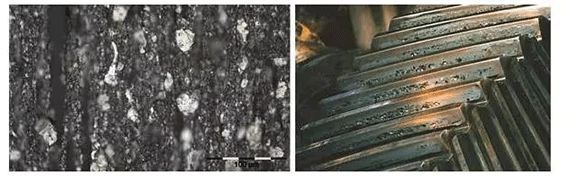
(Left: Metal fatigue Right: Crater formed by metal surface wear)
Test method
Oil testing can detect small particles in the oil and also detect early wear of equipment. By detecting the particle count in the oil, we can understand the cleanliness of the oil and whether particulate pollutants have entered. Additionally, through metal analysis, we can identify early wear and tear of the equipment.
If particulate matter is found to have entered the lubricating oil, the general remedial measures include: finding where the particulate matter came from, blocking the source, filtering it out, and removing the particulate matter - however, this approach may not always be effective. Sometimes it is difficult to completely remove particulate matter when filtering oil, and the oil needs to be replaced.
Water content
Moisture is a common pollutant, although not as harmful as particulate matter, it can damage lubrication, deteriorate oil, cause equipment wear, and also cause metal corrosion. Lubrication relies on the formation of an oil film between metal contact surfaces, which separates direct friction between metals and prevents direct contact between them. If moisture enters the metal contact stress area of the bearing, it will damage the integrity of the oil film, reduce the strength of the oil film, lead to poor lubrication or direct friction between metals, resulting in metal scratching and fragmentation. In addition, water can cause the loss and consumption of antioxidants in lubricating oil, leading to the oxidation and deterioration of lubricating oil. Oxidation of lubricating oil can form acidic substances, sludge, and paint film, increase the viscosity of the oil, and affect the effectiveness of splash lubrication, etc.
Test method
On site, the appearance of the lubricating oil can be observed. If the transparency, whiteness, turbidity, or emulsification of the lubricating oil decreases, it indicates that water has entered the oil. In addition, heating is also a simple and feasible method. This method can make the most basic judgments and is easy to operate. Use a piece of iron, heat it on fire to around 130 ℃, and drop a drop of lubricating oil on the iron. If there is water, bubbles will be observed because the water in the oil evaporates due to heating. The larger and more bubbles there are, the higher the water content. If you can still hear the popping sound of bubbles, it indicates that the water content is relatively high, possibly reaching over 2000ppm. However, the heating method is only applicable for determining emulsified water and free water.
When lubricating oil is found to have entered the water, the correct treatment method is to first find the source of moisture, cut off the source, and then take water removal measures. In severe cases, it is best to change the oil and determine it through oil testing.
Mixing with other lubricating oils
When using lubricating oil, contact with other oils should be avoided. However, in some cases, such as leaks, using the wrong lubricant during refueling (incorrect selection of lubricant viscosity or wrong selection of additive type), etc., different lubricants can be mixed. For example, mineral oil is incompatible with conventional PAG synthetic oil (non oil soluble PAG). If these two types of oil are mixed, it will cause an increase in viscosity of the mixed oil and the formation of sludge. Other phenomena include an increase in acid value and blockage of the filter element by sludge. Meanwhile, due to poor lubrication caused by mixing, equipment wear may also occur.
Test method
When other oils are mixed into the lubricating oil, the solution is to change the oil and flush the lubrication system, and filtration cannot be used to remove them. If the viscosity of the lubricating oil is incorrect, the recommended solution is to replace the oil. For systems with large oil volumes, partial replacement with new oil is required, gradually replacing with lubricating oil of suitable viscosity.
Prev : Discuss the commonly used technical methods for oil monitoring technologyNext : Are there any doubts about the particle counting results? Learn some simple methods for self inspection and handling
文章推荐
友情链接:
Tianjin Honghe Technology Co., Ltd
E-mail:sales01@tjhonghe.com
I would like to call the information hotline:
Tel 022-58956940
Add: 5F, Block C-D, Building 3, No.13 Ziyuan Road, Huayuan Industrial Park, Tianjin
Scan QR code Follow us:

Copyright ©2022 Tianjin Honghe Technology Co., LTD.All Rights Reserved ICP record No. 19008642 -1
\©2022 Tianjin Honghe Technology Co., LTD. All Rights reserved
ICP备案号津ICP备19008642号-1
 客服1
客服1

