 English
 中文
中文


Application of Particle Counting Technology in Filtering Performance Testing
Click:
Time:2022-03-18 00:00:00
With the development of modern technology and the advancement of testing techniques, there is an increasing demand for online measurement and monitoring of production processes in terms of automation and large-scale production. Online detection technology is an important means to ensure the accuracy of test results and has been widely used in various fields of national defense and civil industry in recent years. At present, this technology also has considerable mature application experience in pollution detection and filter performance evaluation of liquid filtration systems.
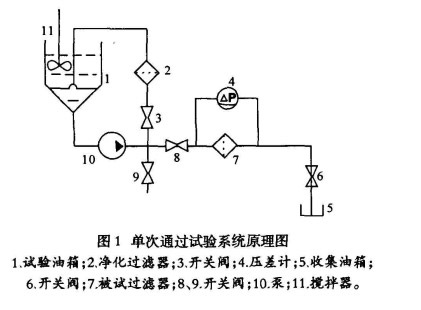
Automatic particle counting technology is mainly applied in single pass and multiple pass methods for filter detection. During the experiment, the test dust can be added to the testing system in one or multiple batches, or continuously. According to the way the experimental dust passes through the filter, the detection method can be divided into two types: single pass and multiple pass. In a single pass test, the test dust added to the system only passes through the test filter once (as shown in Figure 1). If it is a non circulating system, the oil in the system does not circulate. The oil mixed with test dust in the upstream oil tank of the test filter flows into the downstream oil tank after passing through the filter; If it is a circulatory system, the part of the test dust upstream of the test filter that has not been filtered out by the filter will be filtered out by the high-precision filter downstream.
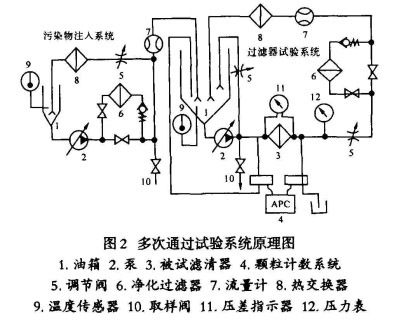
The content of multiple experiments includes evaluating the filtration ratio of filters for different particle sizes, flow characteristics, and fouling capacity. During the experiment, the system's oil is circulating with a constant flow rate. Pollutants are continuously injected into the test oil tank, and the pressure difference between the two ends of the test filter is monitored using a differential pressure gauge. Oil samples are taken from both upstream and downstream of the filter, and an online particle counter is used to analyze the particle count of the oil sample. The particle count at the specified time and pressure difference is calculated, and the filtration ratio and pollutant holding capacity are calculated to evaluate the filtration performance of the filter.
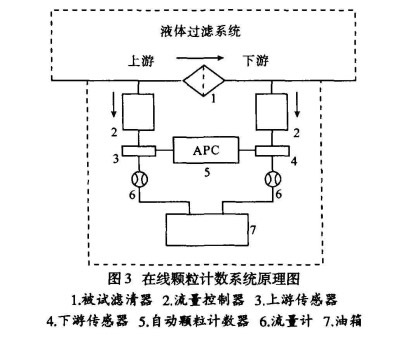
The online particle counting system mainly consists of an automatic particle counter and a flow controller. The automatic particle counter and flow controller are used in combination to perform online particle analysis on the fluid system: a small portion of the flow is diverted from the upstream and downstream of the filter, and flows through the upstream and downstream particle counters for measurement, and then the filtration ratio is calculated. Due to the fact that online particle analysis samples over time and requires stable flow through sensors, the flow controller is directly connected to the system pipeline to control and regulate the flow through the sensors.
The LPC-O online particle counter is a specially designed instrument by Honghe to evaluate the filtration performance of filters (filter cartridges) through multiple experiments. It comes with a high-precision bidirectional plunger pump and does not need to be used with other flow controllers. The injection speed is stable and the sampling accuracy is high. In multiple experiments, the LPC-O particle counter can continuously detect the concentration of pollutant particles upstream and downstream, thereby obtaining the filtration efficiency and filtration ratio of the filter (cartridge), fully meeting the relevant requirements of the standard "GBT/18853-2002 (ISO16889:1999) Multiple pass Method for Evaluating the Filtration Performance of Hydraulic Transmission Filters".
It should be noted that when using online particle counter technology to measure or detect the pollution status of system oil, the particle concentration of the liquid sample must be lower than the particle concentration limit of the sensor used. Otherwise, two or more particles may pass through the sensor window at the same time, causing counting errors.

Prev : Operation Guide for Honghe LPC-O Online Particle CounterNext : Principles for selecting sampling points in system pipelines
文章推荐
友情链接:
Tianjin Honghe Technology Co., Ltd
E-mail:sales01@tjhonghe.com
I would like to call the information hotline:
Tel 022-58956940
Add: 5F, Block C-D, Building 3, No.13 Ziyuan Road, Huayuan Industrial Park, Tianjin
Scan QR code Follow us:

Copyright ©2022 Tianjin Honghe Technology Co., LTD.All Rights Reserved ICP record No. 19008642 -1
\©2022 Tianjin Honghe Technology Co., LTD. All Rights reserved
ICP备案号津ICP备19008642号-1
 客服1
客服1

